
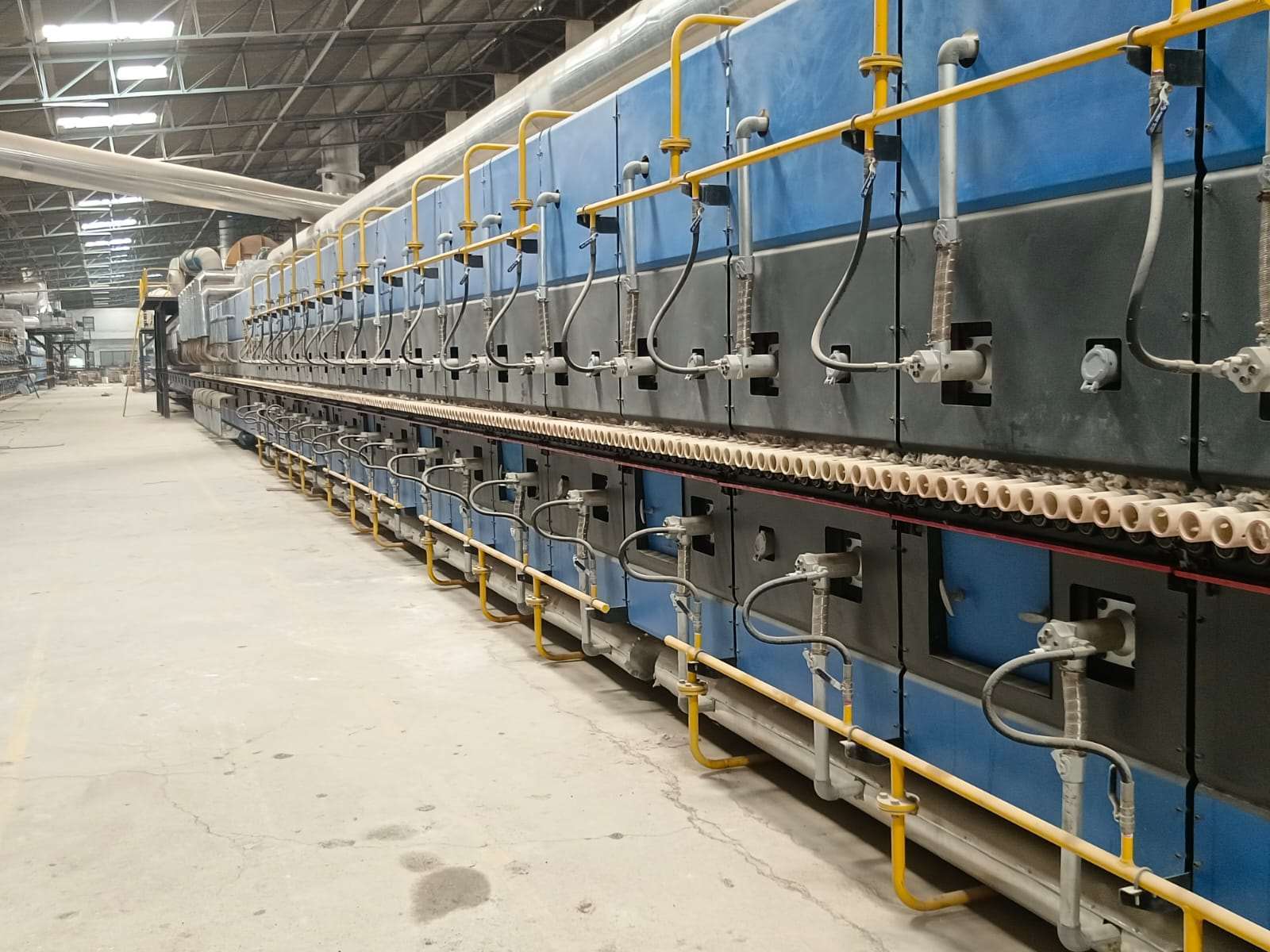
A roller kiln is a continuous industrial kiln in which ceramic tiles travel on a bed of rotating rollers through heating, firing and cooling zones. It is the standard kiln for modern floor tiles, wall tiles, vitrified (GVT/PGVT) tiles and large-format slabs, because it fires tiles quickly, evenly and with low fuel use.
How a roller kiln works
Tiles enter one end of a long, insulated tunnel and are carried along by hundreds of rollers turning at a controlled speed. Burners above and below the roller plane heat the tiles from both sides. The roller speed and the length of the kiln set the firing cycle, the time each tile spends inside.
The zones of a roller kiln
- Pre-heating zone: tiles are heated gradually, remaining moisture is driven off and organic matter burns out.
- Firing zone: tiles reach peak temperature (around 1,200 °C for porcelain tiles), where the body vitrifies and glazes mature.
- Rapid cooling: air cools the tiles quickly down from peak temperature.
- Slow (indirect) cooling: cooling is controlled carefully around 573 °C, where quartz in the tile body changes volume and tiles can crack if cooled too fast.
- Final cooling: tiles leave the kiln cool enough for sorting and packing.
Main parts
- Rollers: heat-resistant ceramic rollers in the hot zones carry the tiles; the roller drive keeps them turning in sync.
- Burners: sets of burners in each zone, above and below the tiles, usually fired by natural gas or LPG.
- Control system: modern kilns monitor temperature, flow rate and air/gas ratio for every burner set and store recipes for each product.
- Heat recovery: hot air from the cooling zone can be ducted to the dryers, cutting overall fuel use.
Roller kiln vs tunnel kiln
In a tunnel kiln, products are stacked on kiln cars that move slowly through the kiln, so firing takes many hours. Tunnel kilns are still used for sanitaryware and heavy refractory products. A roller kiln fires tiles in a single layer with no kiln cars to heat, so firing is far faster and uses less energy per square metre, which is why tile plants use roller kilns.
Single layer, double layer and ultra-wide kilns
A single layer roller kiln has one roller plane and suits slabs and large formats. A double layer kiln stacks two planes to save floor space. An ultra-wide roller kiln widens the firing channel so more tiles travel side by side, raising output per metre of kiln. See kiln width vs length.
Roller kilns in India
Indian tile plants originally imported their roller kilns. In 2001, Morbi-based JAYGANESH MACHINERY was founded and went on to build India's first indigenous ceramic tile roller kiln, for Captain Ceramic Pvt Ltd. Today Indian-built kilns fire tiles in Morbi, one of the world's largest tile clusters, and in plants abroad. Talk to our engineers about a kiln for your plant.