
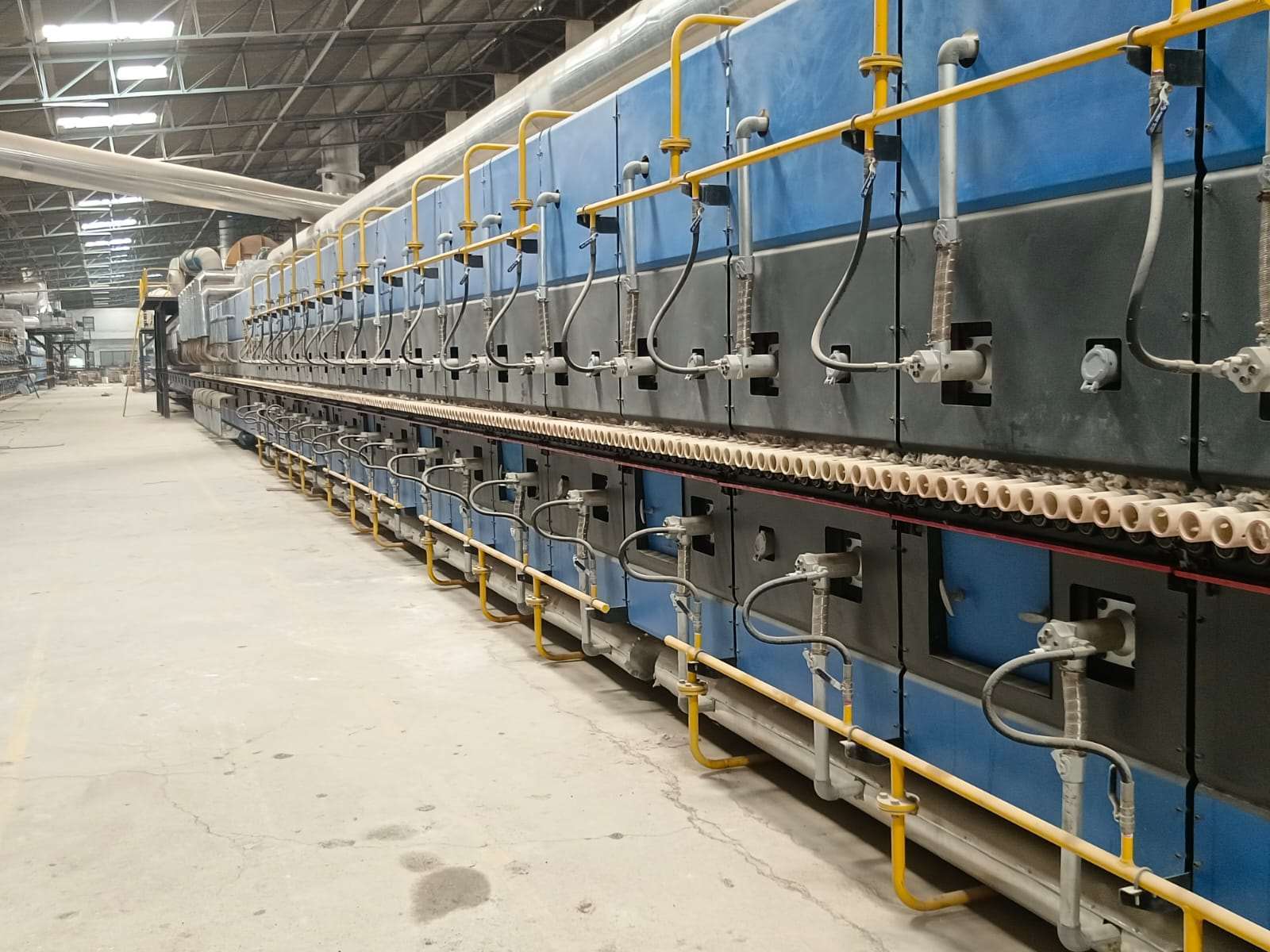
Both single and double layer roller kilns are proven technologies. The right choice depends on your building, your product mix and your capacity plans.
Single layer roller kiln
One roller plane fires one product at a time. This is the standard choice for large-format slab and GVT/PGVT production, because the roller plane can be made wide and the firing curve tuned precisely for one product. Access for maintenance is simple. See our single layer roller kiln.
Double layer roller kiln
Two roller planes are stacked, each with its own temperature control. The main advantages are floor space (up to about 40% less than two single-layer kilns) and flexibility, because each level can fire a different product at the same time. See our double layer roller kiln.
Quick comparison
| Single layer | Double layer | |
|---|---|---|
| Best for | Slabs, large formats, GVT/PGVT | Wall and floor tiles, mixed products |
| Floor space | Larger | Up to ~40% less than two single kilns |
| Flexibility | One product at a time | Two firing curves at once |
| Maintenance access | Easiest | More complex |
How to decide
If your main product is large-format slabs, a single layer kiln, or our ultra-wide kiln, is usually the best fit. If space is tight or you make several smaller formats, a double layer kiln can be the better investment. Ask our engineers for a recommendation based on your plant.